
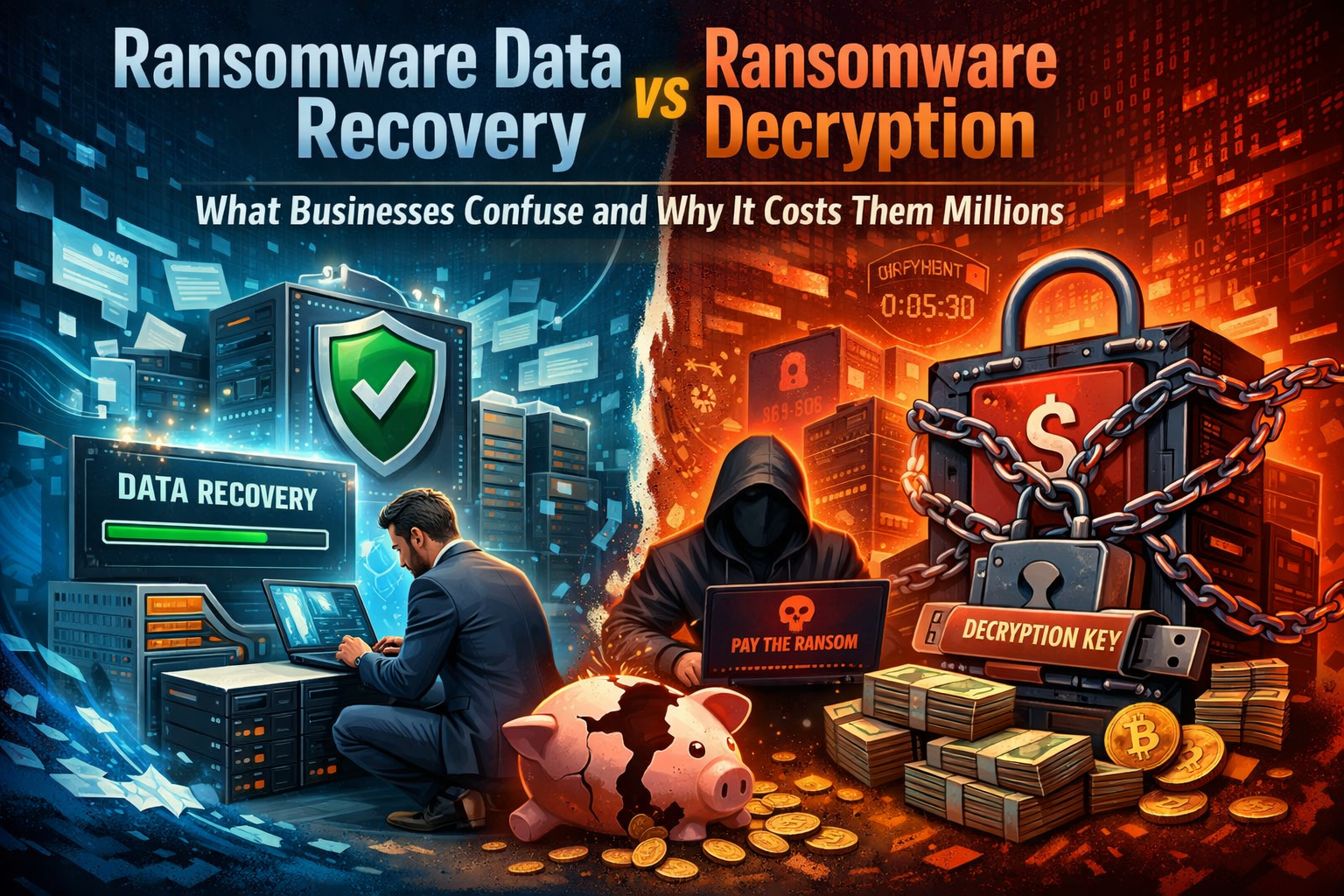
When a ransomware attack hits, most businesses assume there is only one way out. Get the decryption key, restore the files, move on. That assumption is wrong, and it is one of the most expensive mistakes organizations make after an attack.
In reality, ransomware data recovery and ransomware decryption are two very different processes. Confusing them leads to unnecessary ransom payments, permanent data loss, extended downtime, and legal exposure. Many organizations destroy recoverable data within the first few hours simply because they do not understand the difference.
This article explains, in clear and practical terms, how ransomware data recovery differs from ransomware decryption, why businesses mix them up, and how choosing the wrong approach has already cost companies millions.
Engaging professional ransomware recovery services early is often the single factor that determines whether data is restored safely or lost forever.
TL;DR
- Ransomware decryption depends on attacker-controlled keys
- Ransomware data recovery often works without decryption
- Paying ransom does not guarantee usable data
- Early technical mistakes permanently destroy recovery options
- Understanding the difference saves money, time, and data
Table of Contents
- Why businesses misunderstand ransomware recovery
- What ransomware actually does to your data
- What ransomware decryption really involves
- What ransomware data recovery actually means
- Key differences between recovery and decryption
- When ransomware data recovery works without decryption
- How confusion leads to multimillion-dollar losses
- How to choose the right path after an attack
- Final takeaways for business leaders
Why Businesses Misunderstand Ransomware Recovery
Most ransomware response decisions are made under pressure. Systems are down, revenue is impacted, and leadership demands immediate answers. In this chaos, teams often rely on surface-level information or vendor messaging that oversimplifies recovery.
Another reason for confusion is language. Many vendors use the word “recovery” loosely when they actually mean decryption. This creates the false belief that recovery is impossible unless the ransom is paid.
The truth is that ransomware data recovery services and decryption serve different purposes and rely on entirely different technical foundations. Treating them as interchangeable is where things go wrong.
What Ransomware Actually Does to Your Data
Contrary to popular belief, ransomware does not always encrypt everything cleanly.
In real-world incidents, ransomware may:
- Encrypt only specific file types
- Skip locked or in-use files
- Fail midway due to system interruptions
- Corrupt file system metadata
- Leave logs, snapshots, and residual data untouched
This means that even when files appear encrypted, usable data may still exist underneath. File systems, databases, virtual disks, and storage arrays often retain recoverable structures that attackers fail to destroy.
This is the foundation of ransomware data recovery.
What Ransomware Decryption Really Involves
Ransomware decryption is a cryptographic process. It requires the correct decryption key that matches the encryption algorithm used by the attacker.
Decryption usually depends on:
- Paying the ransom and trusting the attacker
- Public decryptors for known ransomware variants
- Rare law-enforcement or security research breakthroughs
However, decryption has serious limitations.
Attackers may provide:
- Incorrect or incomplete keys
- Keys that corrupt large files
- No keys at all after payment
Even when decryption succeeds, it only reverses encryption. It does not recover deleted files, corrupted databases, broken virtual machines, or damaged file systems.
This is why relying solely on decryption is risky.
What Ransomware Data Recovery Actually Means
Ransomware data recovery focuses on restoring data without relying on attacker cooperation.
Professional ransomware data recovery involves forensic and storage-level techniques such as:
- Snapshot and shadow copy analysis
- Database transaction log recovery
- Virtual machine disk reconstruction
- File system metadata rebuilding
- Extraction of residual unencrypted blocks
This approach evaluates what data can be reconstructed from system artifacts that ransomware failed to destroy.
Unlike decryption, recovery does not require ransom payment and does not depend on attacker honesty.
Ransomware Data Recovery vs Ransomware Decryption. Key Differences
The differences between these two approaches are fundamental.
Ransomware decryption
- Depends on attacker-provided keys
- High uncertainty and risk
- Often involves ransom payment
- Limited to reversing encryption only
Ransomware data recovery
- Independent of attackers
- Focuses on system-level reconstruction
- Often avoids ransom payment entirely
- Can restore usable data even without keys
A trusted ransomware recovery company will always assess recovery options first, before attempting decryption or advising payment.
When Ransomware Data Recovery Works Without Decryption
Many businesses assume recovery is impossible without a decryption key. This assumption is incorrect.
Recovery may succeed without decryption when:
- Ransomware only partially encrypted storage
- Databases retain intact transaction logs
- Virtual machine snapshots remain accessible
- File systems preserve metadata and structure
- Encryption routines were flawed or interrupted
Enterprise systems such as databases, VMs, NAS, and RAID arrays frequently retain recoverable data even after severe ransomware attacks. This is why system-specific Ransomware recovery solutions are critical.
How Confusion Leads to Multimillion-Dollar Losses
Confusing recovery with decryption causes four major failures.
- Unnecessary ransom payments
Many organizations pay simply because they believe decryption is the only option. - Permanent data destruction
Re-imaging systems, restoring partial backups, or running automated tools can overwrite recoverable data. - Extended downtime
Failed decryption attempts delay proper recovery, compounding operational losses. - Legal and compliance exposure
Ransom payments may violate regulatory guidance, cyber-insurance conditions, or internal governance policies.
Organizations that skip professional Ransomware Recovery Services early often pay far more than the ransom itself.
How to Choose the Right Path After a Ransomware Attack
The correct response starts with assessment, not action.
Before choosing decryption or recovery:
- Isolate affected systems carefully
- Avoid rebooting or re-imaging prematurely
- Preserve logs, snapshots, and system images
- Consult specialists experienced in ransomware incidents
Ask providers:
- Can recovery be attempted without decryption?
- What data types are realistically recoverable?
- What actions must be avoided immediately?
A structured Ransomware Solution focuses on preserving options first, not rushing into irreversible decisions.
Final Takeaways for Business Leaders
Ransomware data recovery and ransomware decryption are not interchangeable.
Key points to remember:
- Decryption depends on attackers. Recovery often does not
- Many ransomware incidents allow recovery without ransom
- Early mistakes permanently reduce success rates
- Expertise matters more than speed
Businesses that understand this difference regain control faster, lose less data, and avoid unnecessary financial and legal damage.
About the Author
AS Data Recovery Technical Team
The AS Data Recovery technical team specializes in enterprise ransomware incidents involving servers, databases, virtual machines, NAS, and RAID storage. Their focus is forensic-safe data recovery, ethical incident response, and helping organizations restore critical data without unnecessary ransom payments.